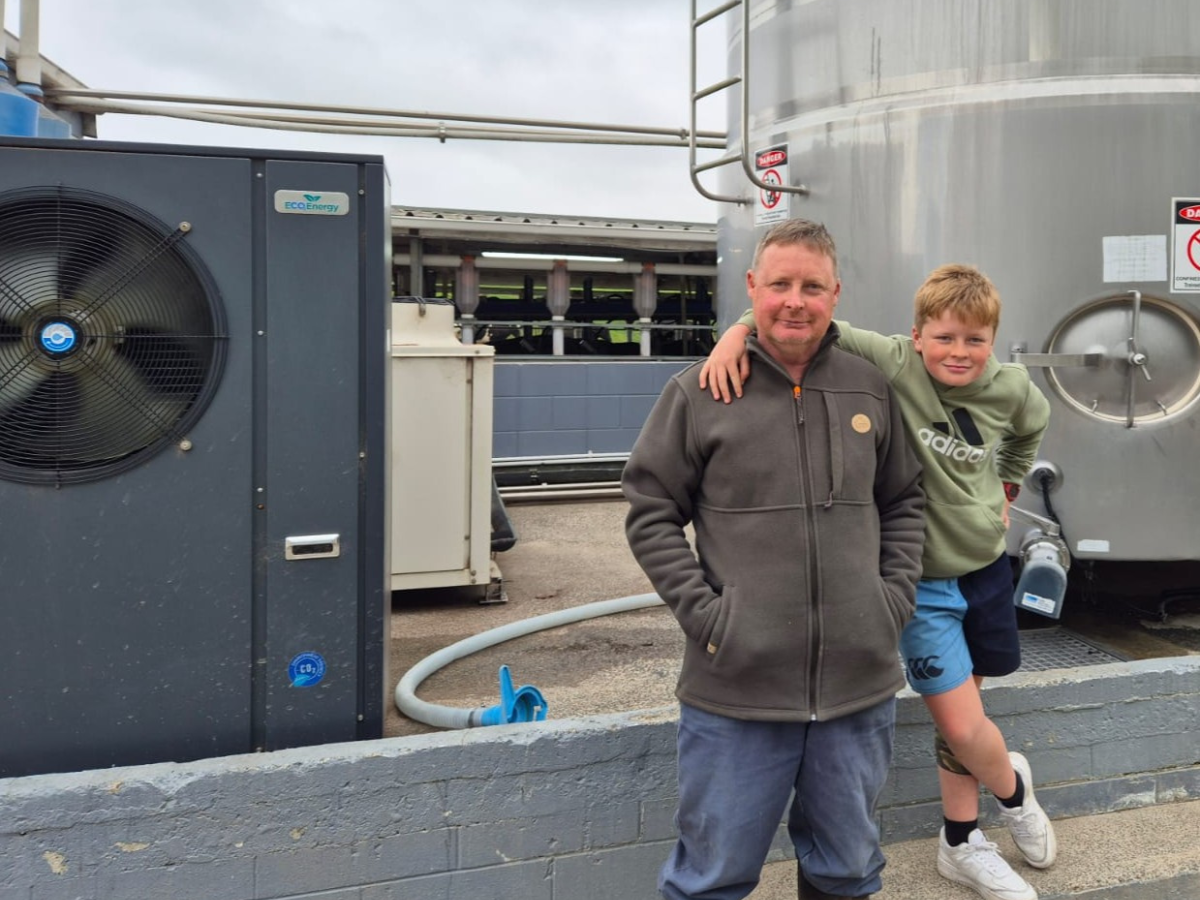
Farmers encouraged to future-proof refrigeration systems as pressure grows on 400-series refrigerants

New Zealand dairy farmers are being encouraged to take a closer look at the refrigerants running inside their on-farm systems, as international and domestic pressure continues to build on high global warming potential (GWP) 400-series refrigerants.
On dairy farms, refrigerants play a critical role in everyday operations. They are essential in milk cooling systems that protect milk quality and are also increasingly being used in heat pump technologies that provide hot water for plant, silo and equipment wash-downs.
According to refrigeration engineer and Eco2Energy founder Nick Papa, most existing dairy refrigeration systems were installed when 400-series refrigerants were the industry standard.
“Currently, around 70 percent of dairy farm refrigeration systems are running on 400-series refrigerants, with a further 20 percent using high GWP hydrofluorocarbons (HFCs), and the remaining 10 percent made up of lower GWP refrigerants, particularly for milk cooling.,” says Nick. “That’s what the industry has relied on for years, but the landscape is changing.”
New Zealand is committed to an international phase-down of high global warming potential (GWP) refrigerants under the Kigali Amendment to the Montreal Protocol. This international agreement requires participating countries, including New Zealand, to gradually reduce the production and use of hydrofluorocarbons (HFCs) – the category of gases that includes many commonly used 400-series refrigerants.
Nick says the key issue for farmers is not an overnight ban, but long-term certainty.
“The biggest risk for farmers is investing in equipment that becomes harder or more expensive to service over time as refrigerant availability tightens and costs increase.”
This is particularly relevant when farmers are upgrading or replacing infrastructure that is expected to last 15 to 20 years or more.
“Milk cooling and hot water systems aren’t short-term investments,” says Nick. “They’re core pieces of farm infrastructure, so refrigerant choice is becoming part of future-proofing an operation.”
As farmers think more strategically about long-term certainty, some are beginning to explore alternatives to high-GWP refrigerants. One option gaining increasing attention is carbon dioxide (CO₂), also known in the refrigeration industry as R744.
“Global warming potential is basically a way of measuring how much damage a refrigerant does if it escapes,” says Nick. “CO₂ is the baseline, so it scores a one. Some of the gases commonly used in dairy refrigeration today score in the thousands, which is why they’re being phased down.”
Nick says CO₂ is a versatile refrigerant that can be used in different ways on farm, depending on how a system is designed. At Eco2Energy, CO₂ is used specifically in heat pump technology to produce high-temperature hot water for dairy shed cleaning and hygiene.
“Modern CO₂ heat pump systems are very efficient at recovering and upgrading heat,” he says. “That means farmers can produce consistent, high-temperature hot water using significantly less electricity. The flow-on benefits can include lower power bills, reduced emissions associated with water heating, and more reliable wash performance.”
Reliable hot water remains critical for milk quality and compliance, especially during busy periods such as calving.
“If wash temperatures aren’t consistently met, there’s a higher risk of residues or bacteria being left behind,” says Nick. “Having reliable hot water takes one more variable out of the system.”
Nick encourages dairy farmers to plan proactively.
“Understanding how refrigerants are used on farm, and where things are heading, helps avoid surprises and supports confident, long-term decision-making.”